

Migration & System Decommissioning
(Regulated) MigrationStrator’s migration methodology is based on ISO 13008 – Digital records conversion and migration process. It combines the standard with an iterative delivery approach, GxP best practices and experience from numerous real-life migration projects.
A Structured and Controlled Approach to Migration in Regulated Environments
The methodology provides a structured approach to planning, analysing, designing, validating and executing migrations. It is designed to reduce uncertainty early, establish control over the migration process and provide confidence that information can be transferred without losing its meaning, integrity or usability.
For migrations in GxP-regulated environments, the methodology is extended with the additional level of governance, risk management, validation, testing and documented evidence required for regulated information.
A Phase-Based and Iterative Approach
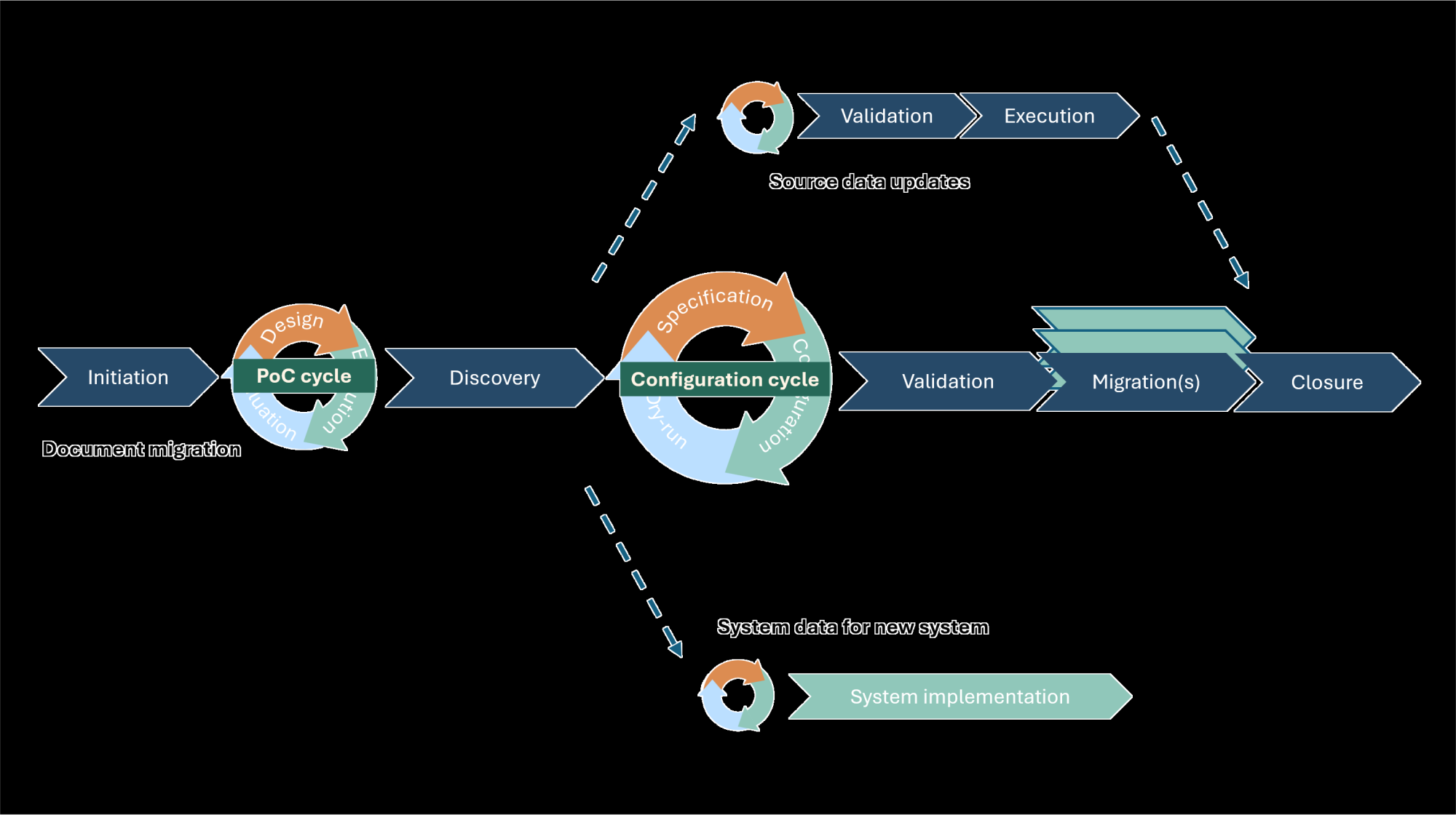
The methodology follows a defined sequence of phases from initiation and analysis through
configuration, validation, migration and closure.
The phases create clear decision points and ensure that important questions are addressed before the migration progresses.
At the same time, the methodology is deliberately iterative. Proofs of concept, configuration cycles and end-to-end dry runs are used to test assumptions, refine mappings and
configurations and resolve issues before the production migration
The Objective
To not only move your information, but to preserve it's meaning, interity and usability.
What the Methodology Achieves
Understand Before Moving
A migration starts with understanding the source information, the target environment and the business processes the information supports.
The objective is to establish what needs to be migrated, what needs to be preserved and what the information must look like and mean in the target environment. And potentially, what is NOT to be migrated, but rather archived elsewhere or disposed of.
Control the Transformation
Migration is rarely a simple copy from one system to another.
Information may need to be classified, mapped or transformed to fit a different information model, metadata structure or system configuration.
The methodology therefore makes these transformations explicit and controlled.
Reduce Risk Through Iteration
Important assumptions are tested before the final migration.
Proofs of concept, configuration cycles and dry runs allow the migration team to identify technical, information-related and process issues early and improve the migration before it is used on production data.
Preserve Trust in the Information
The objective of migration is not only to move information, but to preserve its meaning, integrity and usability. And further, of special importance in GxP environments, have full traceability from source to target.
Demonstrate That the Migration Works
In a GxP context, it is not sufficient simply to assume that the migration has worked.
The migration process must be appropriately tested and validated, and there must be documented evidence that the process performs as intended and that the migrated information is fit for its intended use.
Maintain Traceability
Requirements, mappings, transformations, test activities and migration execution are linked through the methodology.
This creates a traceable migration process that can be understood and explained afterwards.
Built on ISO 13008 – extended for GxP
ISO 13008 provides the foundation.
The standard provides guidance for the conversion and migration of digital records and addresses areas such as planning, metadata, quality control and testing.
Strator adds the practical migration model.
Our methodology combines the standard with an iterative approach and practical experience
from migration projects.
GxP adds the required level of control and evidence.
Where information supports regulated processes, the methodology is applied with appropriate
risk management, validation, testing, approvals and documentation

Get started with your migration!
Free, no-obligation preliminay meeting.
Meeting with Strator is free, no strings attached, and doesn't come with any obligations or expectations. It is simply a way to familiarise yourself with our services and processes.